A flawless answer
Type a debatable question into a chatbot: “Should a company be allowed to replace workers with AI?” The answer arrives in seconds. It talks about balance. It acknowledges opportunities and risks. It recommends training, transparency and dialogue among stakeholders. It insults nobody, commits to very little and ends on a reasonable sentence.
It appears neutral. That is exactly why it deserves an autopsy.
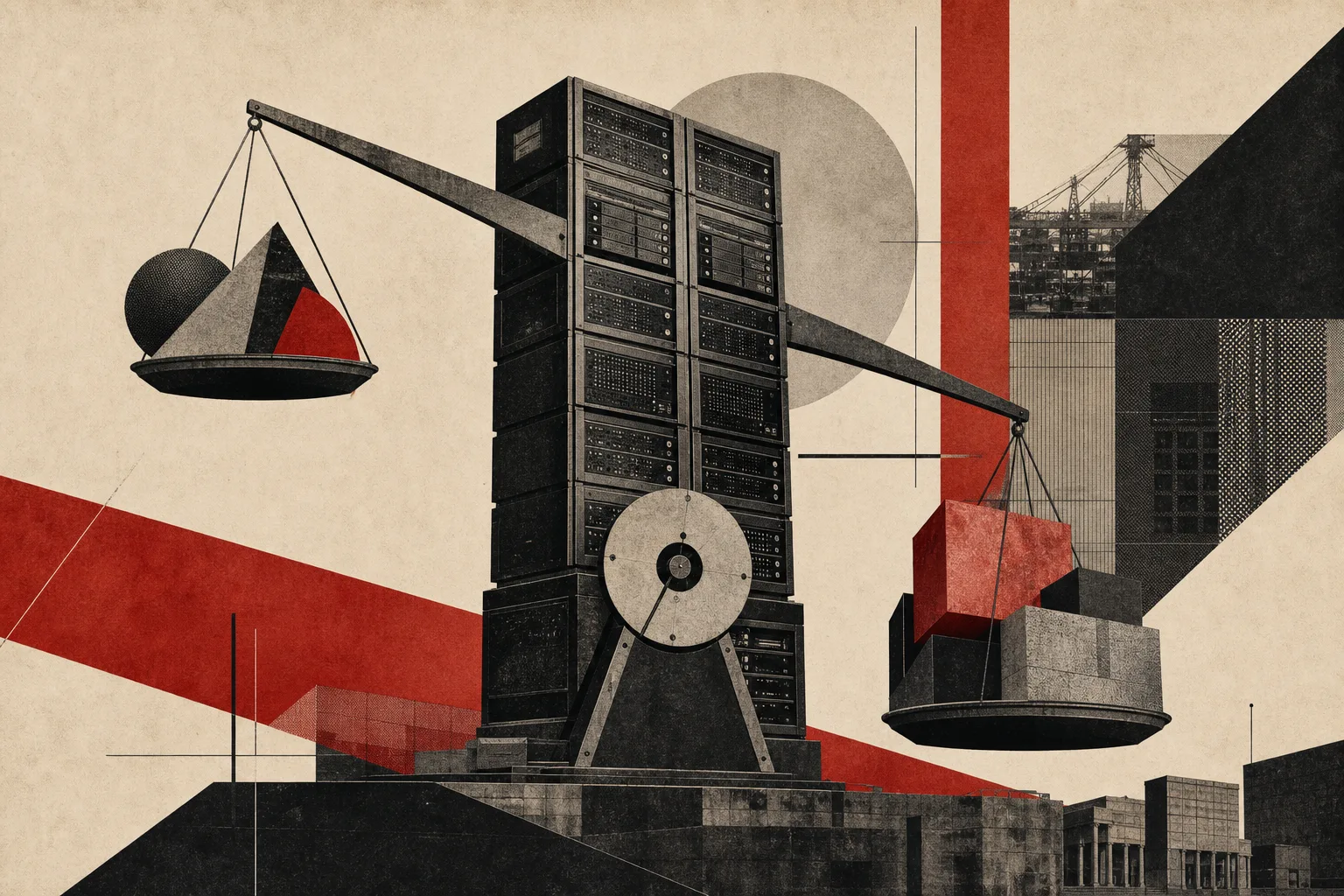
The answer comes from a material chain: text selected at industrial scale, people who judged examples, data centres, chips whose sale is regulated, a company with clients and lawyers, policies defining what the product may say, and a state interested in the technology’s strategic capacity. It may conceal no secret party line. Condensing the world that was able to build it is enough.
Open the corpus
The first layer contains an enormous share of written culture and some very specific absences. The internet overrepresents people with time, connectivity, literacy, safety and a dominant language. Institutions with budgets produce archives, news, manuals and pages designed to be found. Much domestic, working-class, oral and local knowledge never reaches the dataset; some enters only as an object described from outside.
Selection follows. Sources are crawled, purchased or licensed; some are excluded and others retained; duplicates removed; sexuality, violence and personal information filtered; one language is assigned more capacity than another. There is no “raw” corpus. There is an editorial policy executed through software and contracts.
The model learns regularities from that material. If corporate discourse describes dismissal as efficiency and labour conflict as friction, those associations arrive with more statistical support than an untranscribed workplace meeting. A system may repeat an obvious prejudice. It may also do something quieter: place some ideas at the centre of reasonableness and force others to introduce themselves as exceptions.
Find the hands
Before the answer can sound polite, many people must teach it what an acceptable answer looks like. They classify toxicity, compare outputs, write examples, locate errors and endure images or text the company does not want to show its engineers or users.
That work tends to disappear beneath terms such as alignment and human feedback. The abstraction is useful. It presents the model as a feat of computation while repetitive and emotionally punishing tasks travel towards contractors with less pay and less power to complain. The neutral voice rests upon a distinctly non-neutral labour relation.
Evaluators do not apply a universal morality stored in a handbook. They follow instructions: which answer is useful, which danger matters more, which tone sounds professional, which sources count as reliable. When values collide — candour and caution, privacy and surveillance, obedience and protest — somebody sets a priority, even if the finished product calls it “safety”.
Follow the cable
The sentence has physical weight. Servers, electricity grids, cooling systems, semiconductor plants and mining chains produced it. The International Energy Agency’s Energy and AI report estimated that data centres consumed about 415 TWh in 2024, roughly 1.5 per cent of global electricity, and projected more than twice that demand by 2030.
The figure includes data centres unrelated to AI and queries with very different footprints. It still returns the sentence to the physical world. Training another giant model to defend market share consumes power, water, land, chips and grid capacity that cannot be used elsewhere.
Competition creates duplication. Several firms chase similar capabilities so they can own the infrastructure from which others will solve problems and charge them for passing through it. Model scale and corporate concentration therefore grow together.
Read what the answer leaves out
Return to the opening sentence. It speaks of “stakeholders” as though company and workforce enter negotiations with equal information and an equal ability to wait. It recommends training as though the main conflict were an individual skills deficit. It presents replacement as a technical decision to be managed afterwards, rather than an ownership decision that could have been made differently.
Perhaps the model will give the opposite answer when prompted. Flexibility does not make it neutral. A mirror that can take many angles is still installed in a particular room. The interface, default answer, favoured sources, length, refusals and tone form a hierarchy. Millions of small frames may do more to normalise an order than an explicit ban.
Every platform sets boundaries, and some are necessary. Blocking instructions for manufacturing poison protects potential victims. The label “safety” may also cover a wish to avoid legal liability, comply with a government, prevent criticism or preserve a contract. Users need to know the rule, who imposed it and how it can be challenged; otherwise they see only a locked door.
Look at who pays for the room
AI infrastructure already belongs to national rivalries. The United States restricts exports of advanced chips, China promotes its own supply chain and Europe talks of technological sovereignty. In July 2025, the US Department of Defense gave awards worth up to $200 million to Anthropic, Google, OpenAI and xAI to develop AI capabilities for national-security missions.
A company may sell school assistants in the morning and military capacity in the afternoon. It may keep separate teams and different rules. It cannot stand outside the relationship. Contracts fund infrastructure, open markets, orient research and turn the company into a strategic asset. Nor is the state an outside referee: it buys, prohibits, subsidises and names enemies.
Calling a model “American” or “Chinese” does not explain every answer it gives. It does remind us that the system is built inside a bloc with laws, capital, data centres and red lines. The cloud has territory.
Close the autopsy
Evaluating the tool requires reconstructing who could afford it, which labour was hidden and what material was excluded. Its objective should be published, its refusals audited, its energy cost assigned and the authority to change or switch it off made explicit. Searching for a machine “without bias” distracts from those decisions, all of which can be inspected.
Transparency helps only when it supports action. A model card nobody can challenge is another display case. Workers and public services need audit rights; independent researchers need access; whistleblowers need protection; environmental limits must be enforceable; public compute capacity matters; and systems deciding employment, credit, education, health or war require democratic control. In some settings, the right answer will be not to deploy the system.
The chatbot’s sentence remains on screen, tidy and moderate. Once opened, the corpus, the hands, the power station, the boardroom and the public contract come into view. The answer may be correct and still situated inside that chain. Making the chain visible allows responsibility to be assigned.