

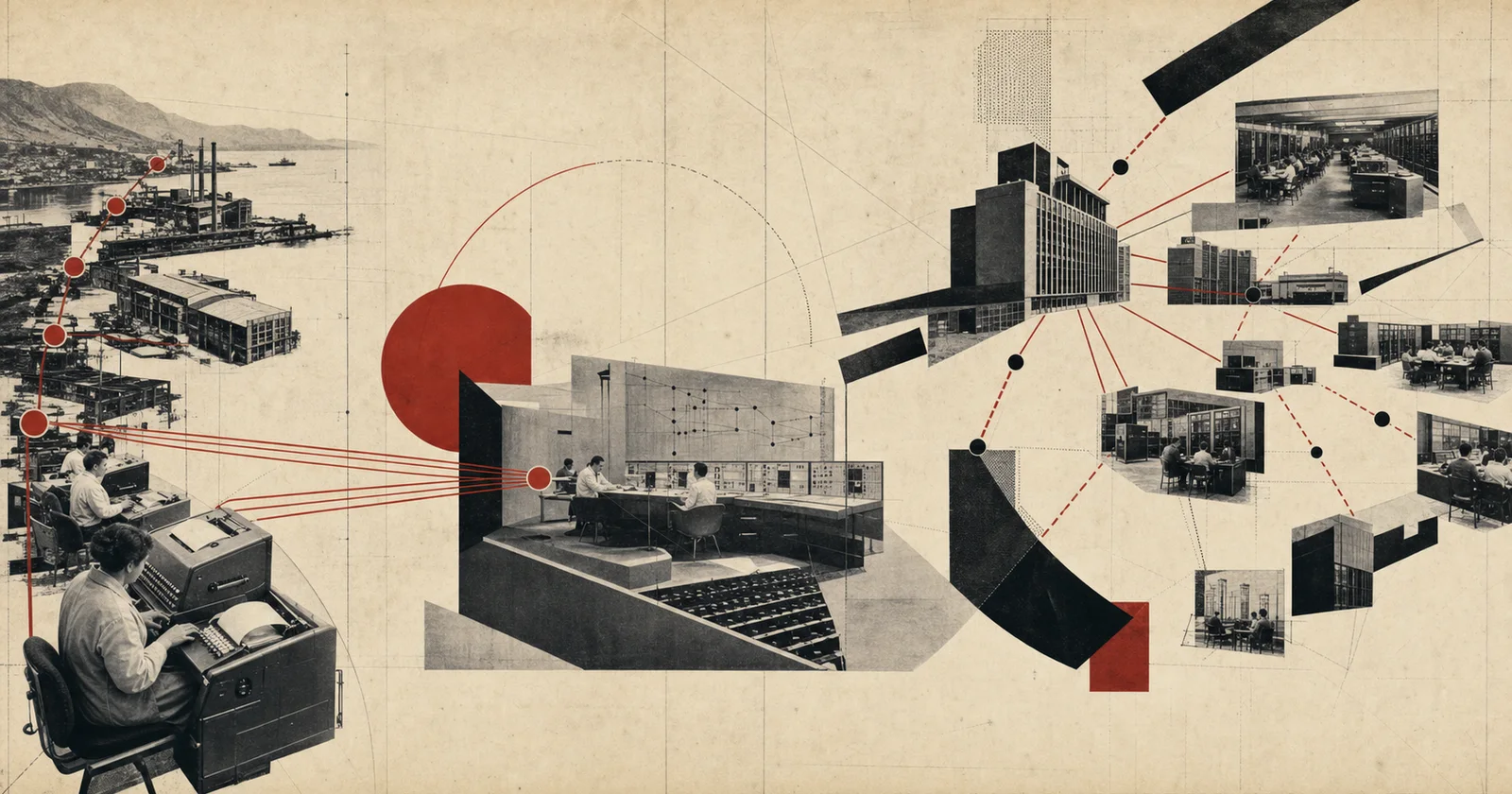
The image that survived Cybersyn is a white room with seven swivel chairs, ashtrays and wall panels. It looks like the cockpit from which Salvador Allende’s government managed the Chilean economy in real time. The room existed. Allende visited the prototype in late 1972. It never operated as the complete control centre suggested by so many reproductions today.
The part of Cybersyn that proved useful had much less graphic appeal: a network of telex machines recovered from storage. During the October 1972 strike by lorry owners, the network carried information about roads, fuel, raw materials and available vehicles. It helped the government maintain distribution in an economy under attack, although it never calculated an optimal national plan.
Distinguishing what was built from what was imagined allows us to learn from the experience.
A revolution with administrative problems
Popular Unity won the 1970 election on a programme of constitutional transition to socialism. It nationalised large-scale mining and rapidly expanded the area of social property. By the end of 1971, the state had incorporated the main mining companies and 68 large industrial firms, according to Eden Medina’s reconstruction in Cybernetic Revolutionaries. Industrial production and popular consumption rose. So did the difficulty of coordinating firms that had previously answered to separate owners.
Chile faced few computers, scarce foreign currency, limited technical staff and an economy under open conflict. Declassified State Department records show that US policy sought to prevent the consolidation of Allende’s government through covert support for the opposition and “selected economic operations”; another 1972 paper called for maximum international economic pressure. Inside Chile, the bourgeoisie retained control over trade, transport, media and the ability to interrupt supplies.
Fernando Flores, an engineer and official at the state development corporation CORFO, wrote to the British cybernetician Stafford Beer in July 1971. He proposed applying Beer’s organisational models to the nationalised sector. Beer arrived in Santiago in November. The Chilean team tried to build in months what ordinary administrations would have turned into years of reports.
Four projects, four degrees of reality
Cybersyn, known as SYNCO in Spanish, brought together four components.
Cybernet was the communications network. The previous government had bought about 400 telex machines that ENTEL kept in storage. The team placed them in factories and offices, using the existing telecommunications network. This was neither the Internet nor a digital packet-switched network. It allowed written messages to travel quickly across the country without waiting for the usual circuit of memoranda.
Cyberstride was the statistical software suite. Each firm had to select a small set of production indicators and define acceptable ranges. Firms sent data to the centre, where the team processed it on the single mainframe that ECOM could spare and used time-series methods to identify deviations. The team wanted to direct attention to exceptions and avoid flooding the centre with late reports. It produced the first test output in March 1972, but modelling each firm required operational studies that remained incomplete in 1973.
CHECO was the Chilean economy simulator. It was meant to test longer-term decisions. Preliminary versions existed; it never became a working twin of the economy or directed national planning.
The operations room would integrate the other components. Its designers arranged the chairs, controls and displays to support collective discussion without a table establishing rank. The panels were not live digital screens. The team had to prepare much of the information as graphics and place it on the wall. The room was a serious piece of interface design and a political promise. It was also the least tested component and the most photographed. Good chairs have a peculiar effect on historical memory.
October: the network finds a task
On 9 October 1972, a strike by lorry owners began and spread to shopkeepers and professional organisations. Chile’s geography made road transport a choke point. The government established a communications centre at CORFO and expanded Cybernet beyond industrial firms.
Beer estimated that the network carried about 2,000 messages a day during the crisis. It reported blocked roads, stocks, urgent requirements and available loyal vehicles. The government used that information to move fuel and essential goods. Historian Eden Medina preserves a distinction often lost in retelling: Cybernet was the first operational Cybersyn component and the only one regularly used by the Allende government.
Its success was organisational. The machines were familiar, transmission depended on people and decisions were made by teams under pressure. Cybersyn shortened the time required for information to reach someone able to act. It did not remove scarcity, black markets, inflation, the collapse of foreign credit or coup violence. Flores eventually recognised those limits. Beer, more enthusiastic, extended his proposals into distribution, consumption and popular participation.
The second employers’ transport strike in August 1973 brought the network back into use. This time information could locate vehicles and routes but could not prevent physical attacks. On 11 September, the armed forces bombed La Moneda, killed the political experiment that made Cybersyn possible and opened a seventeen-year dictatorship.
The worker in the design and the worker in practice
Beer argued that workers should control the system, take part in modelling their factories and enter the operations room. His viable system model distributed decision-making capacity across levels and sought to preserve local autonomy against suffocating centralisation. It contains a valuable communist idea: those who know a process because they work in it should produce the information used to govern it.
Practice did not go as far. Urgency favoured channels connecting company management, CORFO and the government. Worker participation differed sharply between factories and met conflict from managers, parties, technical staff and state structures. The project promised to devolve power to workers while its leadership built a decisive part of the system from above.
Calling Cybersyn democratic by intention does not resolve this contradiction. An indicator can let a workforce govern its factory or let a ministry supervise it more closely. The result depends on who defines the data, who may challenge it, which decisions it triggers and which organisation has the strength to enforce them. Engineers decide how information moves; class struggle decides who can turn it into power.
OGAS: a network trapped inside the ministry
While Chile improvised with telex and one mainframe, the Soviet Union had spent more than a decade debating national computer networks. Anatoly Kitov proposed in 1959 that military and civilian centres be linked to automate part of economic management. The proposal was rejected. After Kitov criticised the Defence Ministry’s computing arrangements, the Party expelled him and the army discharged him.
Viktor Glushkov returned to the problem. In 1964, working with economist Nikolai Fedorenko, he proposed a three-tier network: tens of thousands of local centres collecting primary information, between 30 and 50 intermediate centres in major cities, and a top-level centre serving the government. The same data would no longer travel through four parallel channels for planning, supply, statistics and finance. It would be collected once and made available to authorised bodies.
Glushkov estimated that the project would cost 20 billion roubles over fifteen years. It aimed to reorganise the administrative apparatus, establish responsibilities and automate planning calculations. It also threatened specific monopolies. The statistical administration would lose control over collection; Gosplan would share decision-making capacity; each ministry would have to open its information banks.
Slava Gerovitch’s archival research, published as “InterNyet”, records the outcome. Between 1966 and 1970, ministries constructed 414 management information systems without coordination or a common network. From 1971 to 1975, they multiplied that number almost sevenfold, often using incompatible hardware and software. Ministries computerised their own domains and strengthened vertical control over subordinate enterprises. Sharing data would have meant sharing power.
OGAS returned in later plans, but the national network remained on paper. The Soviet state had overcome greater technical obstacles in its space programme, nuclear weapons and military networks. Shortages of computers and telecommunications mattered, especially for a project of enormous scale. They do not explain why the apparatus produced hundreds of incompatible islands. Benjamin Peters develops this paradox in How Not to Network a Nation: socialist institutions competed over information as if it were private property while the US state funded collaborative environments for ARPANET.
Two scales, one question
Cybersyn and OGAS operated at different scales and addressed different tasks. Chile was trying to maintain and coordinate a new nationalised sector inside a still-capitalist economy, under sabotage and through a contested political road. OGAS sought to remake information flows in a continental state economy administered by ministries with decades of accumulated power.
Pressure opened an institutional space in Chile: the government needed a different form of management, and a small team had authority to test one. Scarcity forced it to reuse stored telex machines, reduce the number of indicators and deliver quickly. The Soviet Union had greater scientific and industrial capacity but no bloc strong enough to expropriate information from the ministries. Technical scale grew faster than the political capacity to transform the apparatus.
Both cases show why centralisation and decentralisation are inadequate words on their own. Cybersyn centralised data to detect problems and intended to return decisions to viable units. OGAS proposed a national data bank and hierarchical centres while promising operational autonomy. The decisive question was which class and which bodies could use the information. A workers’ centre can concentrate knowledge to coordinate solidarity. A private firm can distribute servers around the world while retaining absolute command.
Practices for socialist planning
A supermarket chain now processes more data in minutes than Cybersyn could receive in days. Amazon plans warehouses, routes, inventory and labour with a precision turned into discipline against its workforce. Computing enclosed planning inside large capitals and subordinated its ends to profit.
Contemporary socialist planning can learn from these experiences without copying them. Necessary information should reach someone able to act before it loses value. Workers and users should define indicators, models and avenues of appeal, as well as govern interoperability and data access as property relations.
Worker organisation must retain command over display panels and models. Units that compete or fear sanctions may manipulate the data, and a central room full of specialists may reproduce, at higher speed, the separation between those who conceive and those who execute. A feedback button offers minimal participation.
Cybersyn’s operational experience offers more than nostalgia for its furniture. Its material network, built with scarce means, helped resist an employers’ offensive. Its unfinished programme posed a question that remains open: how to coordinate a complex economy without handing all power to the centre. OGAS demonstrated the reverse problem: a national network cannot socialise information that the state’s own bodies treat as property.
Both projects encountered a balance of forces unable to turn information into common power and sustain it. That balance of forces also determined who could sit in the operations room.
Sources and method
The account of Cybersyn follows Eden Medina’s archival research, particularly Cybernetic Revolutionaries and the excerpt published by MIT Press, checked against Stafford Beer’s lecture “Fanfare for Effective Freedom”. The OGAS section relies on Slava Gerovitch’s academic article “InterNyet: Why the Soviet Union Did Not Build a Nationwide Computer Network” and Benjamin Peters’s archival work in How Not to Network a Nation. The context of US intervention is supported by primary documents in the official Foreign Relations of the United States series. Figures attributed to Beer are presented as his estimates, not as complete independent records.