The demonstration takes twelve minutes
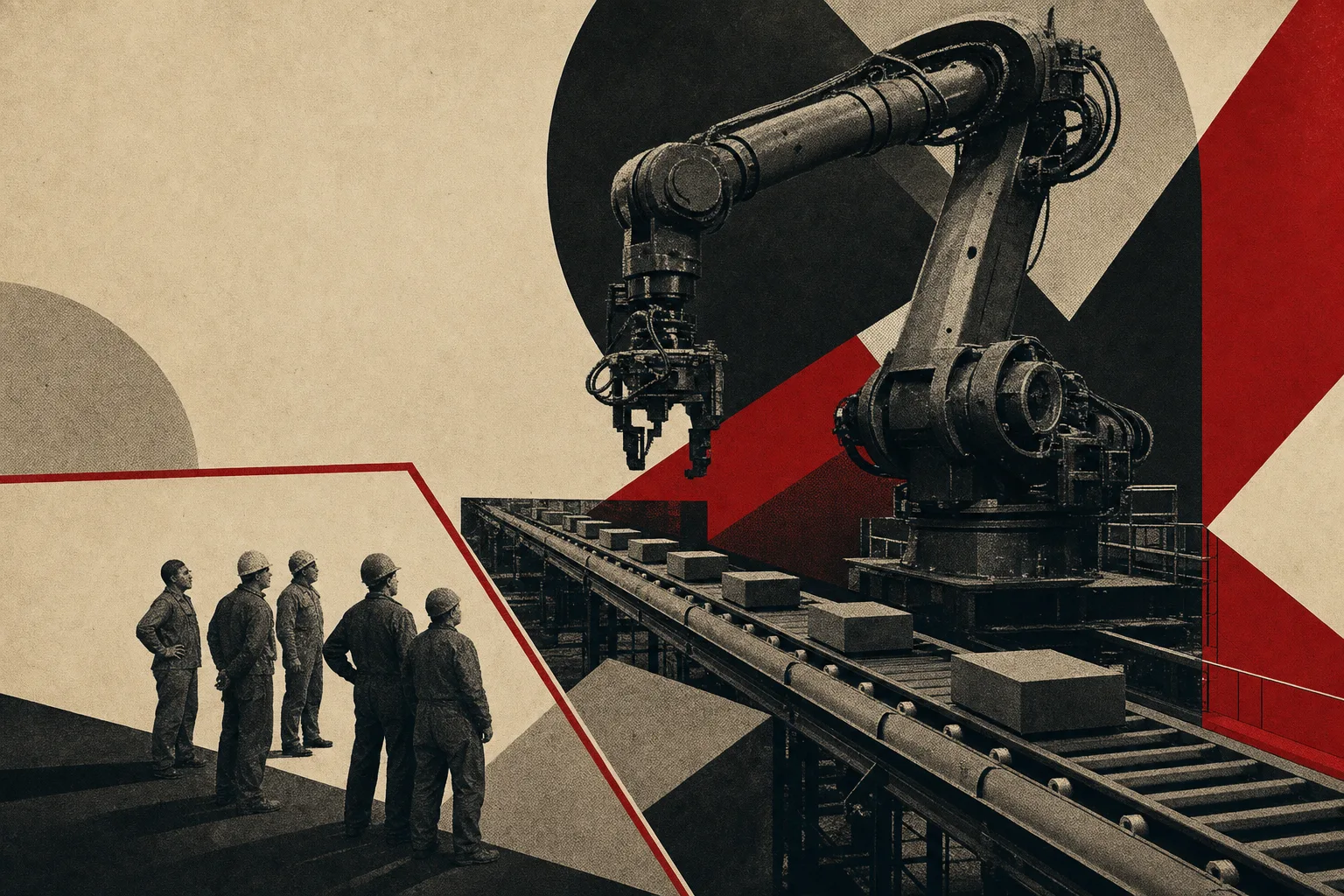
The vendor installs the machine on a Tuesday. During the demonstration, a component enters on the left, two arms do the work and the checked component leaves on the right. Twelve minutes, no visible mistake, one spotless screen. The salesperson talks about precision, continuity and return on investment. The people who have spent years doing the task watch something else: how many jobs fit between the entrance and the exit.
The machine arrives without a politics of its own. It does not know whether the hours it saves will become a shorter working week, higher output, redundancies or enough breathing room to work without injury. Nor does it choose who can inspect its logs or who answers when it fails. Those decisions were already waiting for it inside the company.
This is why “automation destroys jobs” is an unfinished sentence. It describes one result as if it were a natural property of the device. The same technical capacity permits opposite settlements. It can remove an injurious task without expelling the person who did it. It can cut the week without cutting pay. It can raise the pace until those who remain work for the machine. It can dismiss twenty people and turn the wage saving into a dividend. The difference is not inside the robotic arm. It lies in ownership and the power to organise work.
On the spreadsheet, hours have an owner
Suppose the team produced a thousand units with four hundred hours of work each week and now needs two hundred. Two hundred human hours have been released. The phrase sounds emancipatory. Company accounts give them another name: avoidable labour cost.
If ownership remains unchanged, the productivity gain belongs first to whoever controls the firm. The company can sell the same quantity with a smaller payroll or increase output without hiring. The people who made the transition possible — who know the exceptions, correct the data, teach the system and absorb its mistakes — must bargain afterwards for a share of what was gained.
That sequence explains how a society becomes dramatically more productive without the working day falling at the same pace. The Economic Policy Institute calculates that US net productivity grew by 92.4 per cent between late 1979 and late 2025, while compensation for a typical worker rose by 33.6 per cent. The tools improved. Distribution followed another course.
The gap does not prove that technology is useless. It proves something less comfortable: producing wealth and deciding its destination are separate operations. Technical abundance contains no automatic mechanism of distribution.
The ghost is not an empty factory
Talk of AI sends the imagination towards a future without employment. The present is less cinematic. Software drafts the first version, sorts tickets, scores calls or proposes code; then a person checks it, corrects it and carries the responsibility. The task does not vanish whole. It breaks into pieces. The ILO’s 2025 global index reached a similar conclusion: transformation is more likely than complete disappearance for most jobs exposed to generative AI.
Fragmentation makes labour easier to hide. Behind an “autonomous” system may be annotators who cleaned its data, staff reviewing its outputs, operators resolving rare cases and customers turned into unpaid testers. The company presents the minute saved at the visible stage and leaves out the hours displaced to another desk, another country or the user.
The craft changes too. If a system takes all routine cases, a person receives only the difficult and urgent exceptions. They may perform fewer actions and finish more exhausted. If management turns machine output into the new human baseline, automating part of a process does not lighten the rest. It speeds up the belt.
The immediate danger is work distributed worse, monitored more closely and stripped of discretion. The language of replacement also weakens anyone trying to negotiate. A worker who believes they are competing against a machine may accept different terms once the company disappears from view across the table.
A workshop can vote; a machine cannot
Before the equipment is bought, the task to be removed should be named and the hours genuinely released calculated, including maintenance and supervision. The agreement must settle in advance whether the working week will fall, who retains process knowledge and when staff may stop the system. It must also divide later improvements.
In an ordinary firm, those questions are answered above and arrive below as restructuring. Consultation after the contract is signed manages resistance; it does not share the decision. Participation begins when the people who will make and endure the change can open the accounts, debate the objective and veto uses that damage health or employment.
Preserving every job and process for ever would paralyse society. Labour has to move from unnecessary activity into care, housing, transport, science or ecological restoration. Fear enters when income, training and access to another job depend on the profitability of one firm. A social guarantee keeps each change of task from becoming a fall into space.
Abundance begins with the clock
The word abundance usually suggests full warehouses. It is a poor image. Some goods should increase and some consumption must fall; no automation makes land, energy or materials infinite. A rational society would not measure success by producing anything without limit.
The first possible abundance is time outside command. A technique that produces what is needed with less effort should also be measured by the hours it returns and who receives them. A thirty-hour week, safer shifts, retirement without poverty and more hands for care would be technological achievements every bit as real as a faster production line.
That requires taking the decision beyond a private balance sheet. Co-operatives, public ownership and collective bargaining can shift power, but no label guarantees the result. A public enterprise that copies private discipline, or a co-operative forced to compete through self-exploitation, can reproduce the same race. Democratic planning is needed: choosing what to produce, with which resources, how much social labour to devote and how to share reduced working time.
Tuesday’s machine was neither the enemy nor salvation. It was accumulated capacity: generations of knowledge turned into metal, software and electricity. The right question appears when the demonstration ends and somebody opens the spreadsheet. If the saving belongs to the owner, the machine strengthens ownership. If the hours belong to the people who make up society, it can begin to release time.